
How the Cherokee Sheriff’s Office turns overdose data into actionable intelligence
Author
Brenna Swanston
Customer Marketing Manager
Peregrine
Published
May 19, 2025
Author
Brenna Swanston
Customer Marketing Manager
Peregrine
Published
May 19, 2025
Share


KEY IDEAS:
- The Cherokee Sheriff’s Office (CSO) previously tracked overdose data manually, limiting its ability to analyze trends and measure intervention effectiveness.
- The CSO used Peregrine to ingest structured and unstructured overdose data from spreadsheets and other agency sources.
- Dynamic dashboards help personnel visualize overdose trends by location, substance, fatality status, and other factors.
- Integrated data gives the CSO trend-level visibility and person-level context to support targeted overdose response strategies.
💡 THE CHEROKEE SHERIFF’S OFFICE AT A GLANCE:
Location: Cherokee County, Georgia
Established: 1831
Population: Approx. 293,513
Total personnel: Approx. 493
Sources: CSO, U.S. Census
CHEROKEE COUNTY, Ga. — For years, the Cherokee Multi-Agency Narcotics Squad (CMANS) operated with minimal intelligence and analytical support. The task force — comprising representatives from law enforcement agencies in Cherokee and Pickens counties, Georgia — maintained paper case files and lacked the infrastructure to track overdoses, analyze trends, and measure the effectiveness of its interventions.
When Intelligence Division Commander Lindsay Harris joined the Cherokee Sheriff’s Office in 2018, she inherited a daunting but critical responsibility: digitally recording overdose data for Cherokee and Pickens counties. So she started a spreadsheet, where she manually noted information about individual overdoses as calls and reports came in.
Harris soon began noticing patterns and associations in the data, but she still lacked an efficient way to model and analyze it. Peregrine helped the CSO integrate and transform its structured and unstructured overdose data, turning manually tracked information into a foundation for analysis and actionable insights.
Using Peregrine, the CSO turned manually maintained spreadsheets into dynamic dashboards that add context, surface overdose trends, and inform targeted intervention strategies.
READ MORE → Cherokee Sheriff’s Office: Integrated Jail Management for Data-Driven Decisions
When a CMANS agent responds to an overdose-related call or a road deputy files a report on an overdose, Harris records the details in her spreadsheet tracker, pictured below, by hand. She notes:
However, the spreadsheet alone does not provide a way to organize, enrich, and model that data for effective analysis. Before Peregrine, Harris would have had to manually search through pages of information to make connections and identify trends, and she could not have easily analyzed overdose data against other information collected by the sheriff’s office or partner agencies.
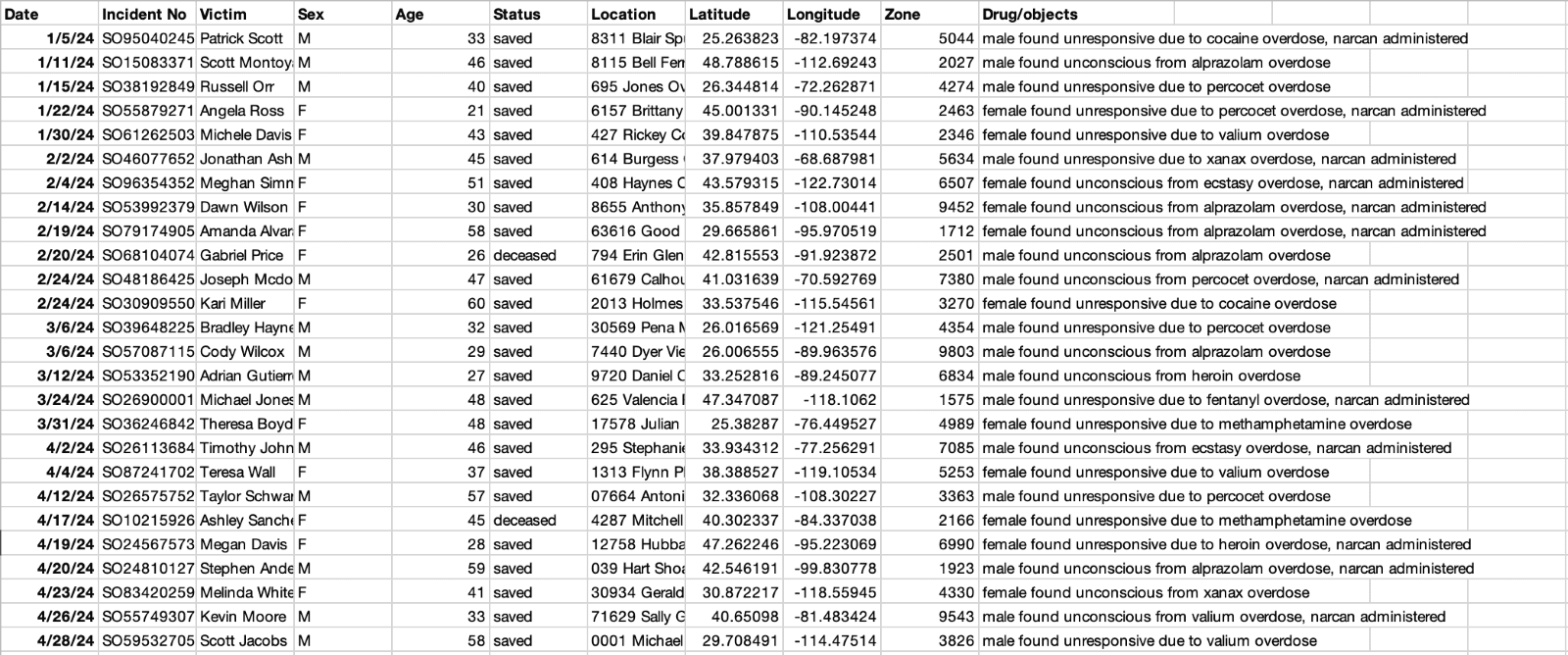
The above image contains notional data.
With such a manual, time-consuming process, the CSO risked missing patterns that were not immediately obvious, delaying decisions about where to focus resources or intervention efforts. To turn that manually tracked information into usable intelligence, the CSO needed a way to structure, enrich, and analyze overdose data as it changed.
🔑 KEY TAKEAWAY: Manual overdose tracking can preserve important information, but it makes trend analysis, resource allocation, and intervention planning harder to scale.
To turn siloed information into usable insights, the CSO onboarded Peregrine, a data integration and analytics platform. Peregrine unified the CSO’s data sources and improved visibility into overdose trends.
The platform now ingests the data from Harris’ spreadsheet and integrates it with information from other data sources across the CSO and participating partner agencies, providing valuable context for each individual incident and for overdose trends more broadly.
Peregrine automates overdose reporting and analysis by populating dashboards, which update in real time as new information is added to the source spreadsheet. Even when the source includes unstructured data, such as the spreadsheet’s free text field, users can filter the dashboards by data points such as:
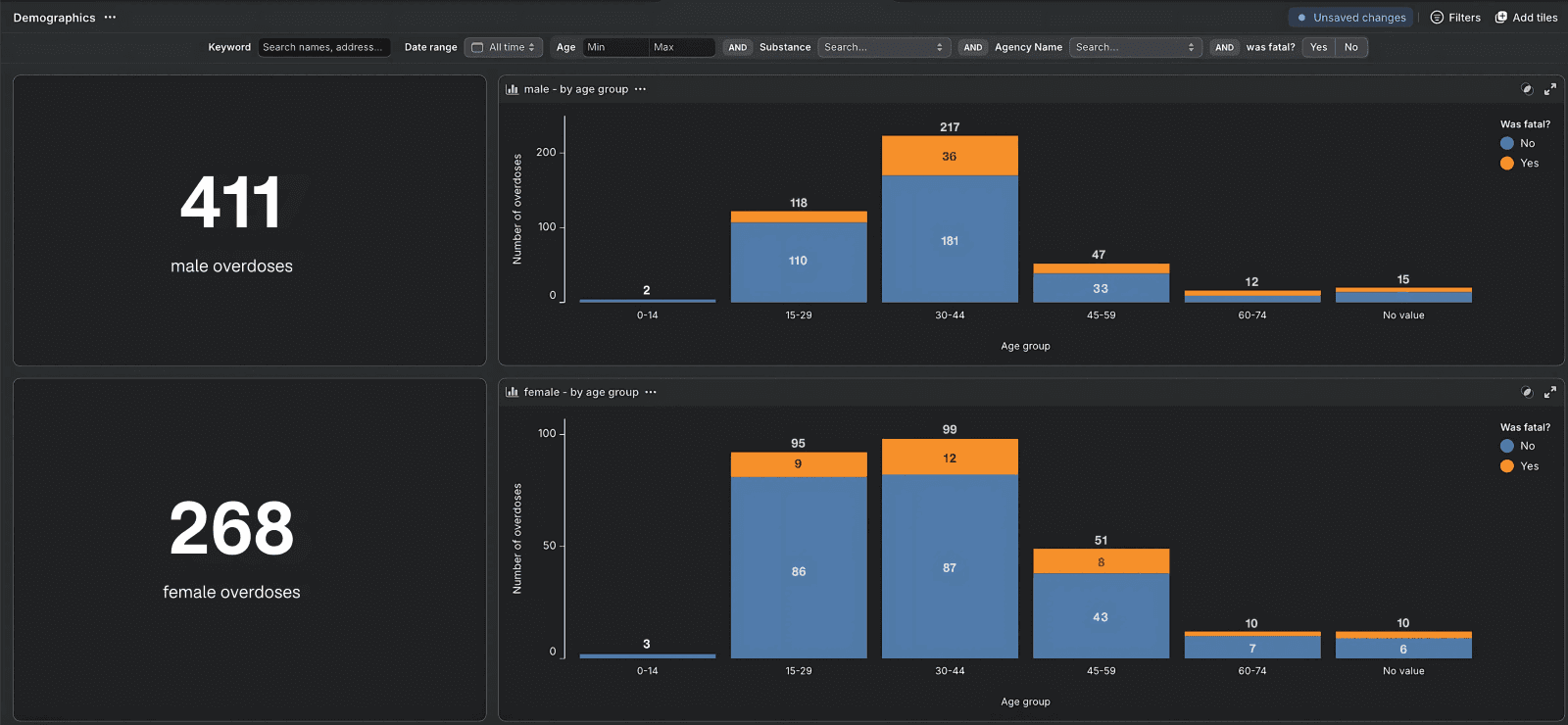
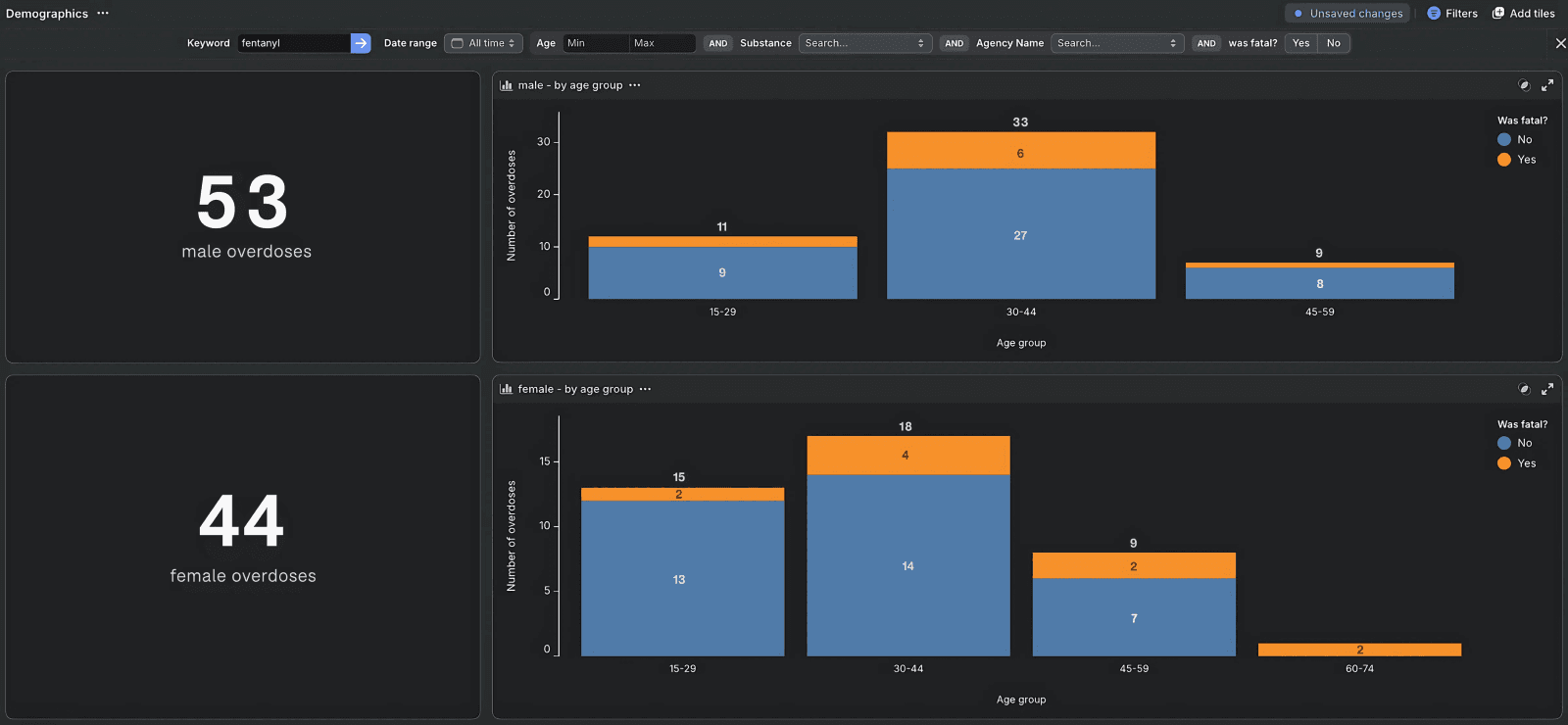
The above images contain notional data.
These dashboards provide faster insights into overdose trends across jurisdictions, allowing personnel to spend more time on high-value analysis that supports better resource allocation and intervention strategies.
🔎 HOW DO OVERDOSE DASHBOARDS HELP PUBLIC SAFETY AGENCIES?
Overdose dashboards help agencies visualize incident trends, filter data by key factors, and identify emerging hotspots so personnel can make faster, more informed resource decisions.
Where the CSO and CMANS previously struggled to visualize and analyze overdose data, analysts can now extract actionable insights to inform targeted intervention strategies. Once overdose data became searchable, filterable, and visual, CSO personnel could begin spotting patterns that were difficult to see in a spreadsheet.
For example, when a Peregrine dashboard showed a heroin overdose hotspot developing in a grocery store parking lot, Harris inferred that there might be a drug dealer nearby. She consulted CMANS’s drug tips to see if she was right.
"We focused our efforts and identified a potential heroin distributor nearby," Harris said. "Subsequently, the dealer was arrested, and this single arrest had a direct impact on the amount of heroin overdoses in that area."
The example showed how trend visibility could help the CSO move from reactive reporting to targeted intervention.
🔑 KEY TAKEAWAY: Trend visibility helps agencies identify emerging overdose hotspots, focus investigative resources, and develop more targeted intervention strategies.
Trend-level dashboards help agencies see where overdose activity is increasing. Person-level context helps them understand who is involved, what prior incidents may be connected, and where intervention may be needed.
Peregrine allows users to drill down to the person level, providing a deeper, more granular understanding of the individuals behind the trends. By integrating data from Harris’ overdose tracker with information from regional agencies’ data sources, Peregrine builds a comprehensive profile of each overdose victim. Users can click into any person’s profile to see:
🧠 WHAT IS PERSON-LEVEL CONTEXT IN OVERDOSE RESPONSE?
Person-level context connects overdose incidents to related records, prior calls, locations, vehicles, associates, and other relevant information so personnel can better understand patterns and potential intervention points.
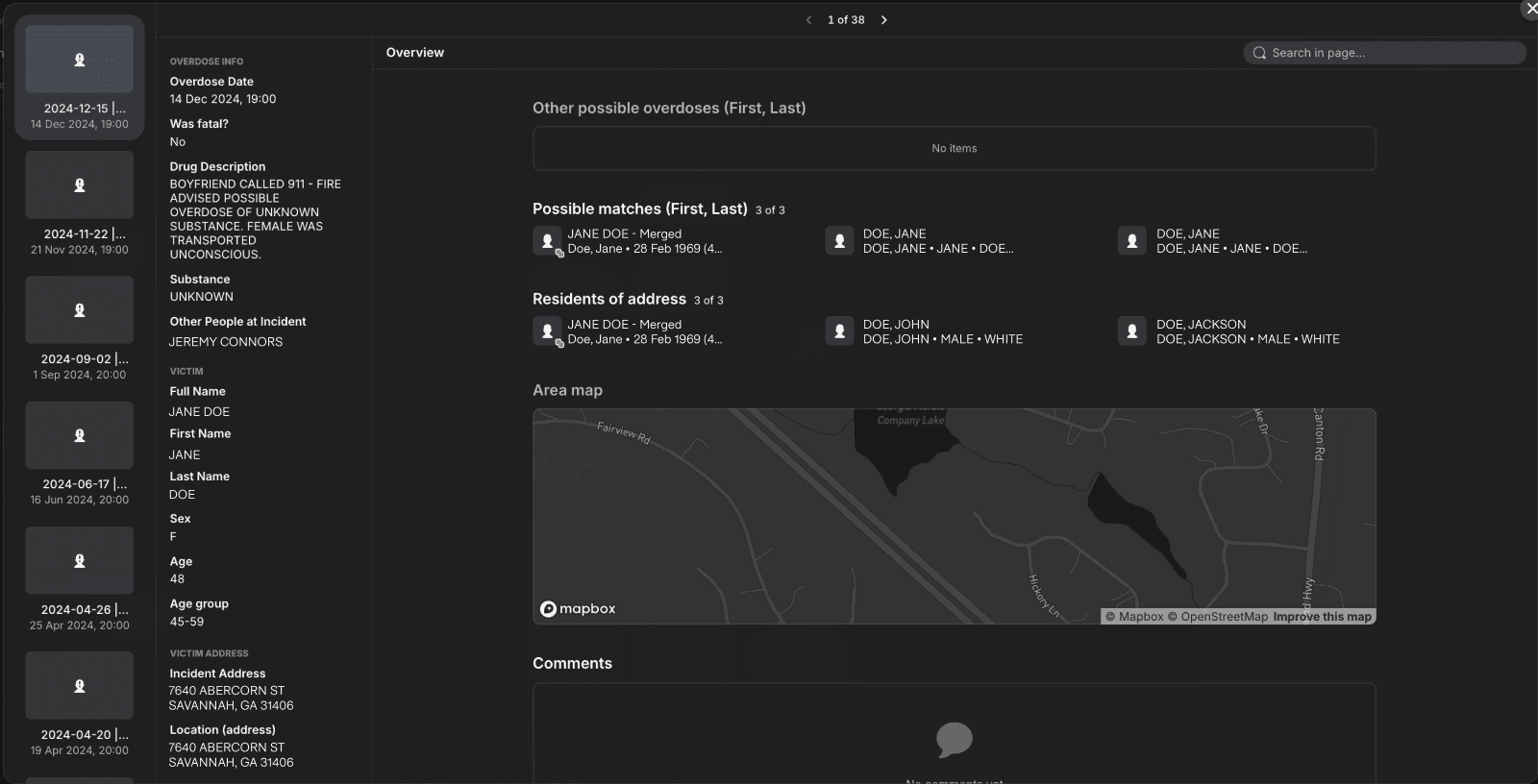
The above image contains notional data.
Peregrine also applies its proprietary Match algorithm to these person records, reducing duplications and redundancies. Peregrine Match merges similar records across all integrated sources into a single unified entity. So even if a person entered the system through different departments or under multiple addresses or name variations, Peregrine presents their record as one clean, comprehensive asset.
Unified data enables the CSO to view more context around individuals and trends, helping personnel identify where their resources are best spent.
🔑 KEY TAKEAWAY: Integrated person-level context helps agencies connect overdose incidents to related records, prior calls, and potential intervention points.
When valuable data lives in silos — like one-off spreadsheets or disparate tech platforms — it’s harder to understand and act on. By integrating those siloed sources in one harmonized data ecosystem, agencies can derive more robust, reliable, and actionable insights from their information. But effective data integration presents complex technical challenges, and not all platforms are up to the task.
🔑 KEY TAKEAWAY: Unified data helps agencies move beyond manual reporting by turning overdose records into searchable, filterable, and actionable intelligence.
Peregrine integrates, cleans, and models structured and unstructured data from spreadsheets, records systems, and other agency sources, creating a reliable data asset that updates as new information becomes available. Contact our team to learn how data integration can streamline analysis and improve community outcomes for your agency.
Overdose data integration is the process of combining overdose-related information from spreadsheets, records systems, 911 calls, reports, and partner agency data into a unified data environment. For public safety agencies, this makes overdose records easier to search, analyze, and visualize so personnel can identify trends, understand context, and make more informed decisions.
Have a question?
Ask usFor media requests,
contact media@peregrine.io
 Your Privacy Choices