
KEY IDEAS:
- The Loudoun County Sheriff’s Office (LCSO) lacked visibility into patrol staffing needs and workload balance.
- Traditional staffing analyses are static, making it difficult to adapt to changing demand.
- By integrating data across dozens of systems, the LCSO enabled real-time analysis of patrol workload and staffing against best practices.
- Using these insights, the LCSO recalculated staffing requirements, optimized shift schedules, and secured funding for 14 additional deputies.
💡 LOUDOUN COUNTY SHERIFF’S OFFICE AT A GLANCE:
Location: Loudoun County, Virginia
Population: Approx. 443,380
Sworn count: Approx. 700
Total personnel: Approx. 900
Sources: LCSO, U.S. Census
LOUDOUN COUNTY, Va. — In April 2022, the IACP conducted a feasibility study of Virginia’s largest full-service sheriff’s office, the LCSO, to evaluate the agency’s lines of business for the county government. The association concluded its study with a list of recommendations, including “that the LCSO conduct as part of their annual workload analysis a temporal analysis to identify the most efficient and effective hours for their patrol deputy shifts.”
That recommendation exposed a critical gap: The LCSO lacked a reliable way to calculate minimum patrol staffing requirements and align shifts to real-world demand in real time.
It also sparked key questions within the agency:
- How are we calculating our minimum patrol staffing requirements, and how should we be calculating them?
- How can we rethink our current shift model to make patrol officers more visible, more effective, and more aligned to the daily workload?
- How do we balance efficiency and community demands on the department with officer wellness and actual resources?
To answer those questions, the LCSO turned to Peregrine. Using Peregrine, the LCSO replaced static consultant analyses with real-time staffing models, leading to approval for 14 new hires and a fully optimized shift structure.
🔑 KEY OUTCOMES: The Loudoun County Sheriff’s Office used Peregrine to run a complex analysis of the agency’s patrol staffing and shifts. That analysis empowered LCSO leaders to:
- Use workload data, rather than historical precedent or instinct alone, to inform minimum staffing requirements
- Leverage objective, demonstrable data to request additional staffing resources from the county, resulting in the approval of 14 new deputy positions
- Propose more efficient shift structures based on staffing best practices and historical trends in call volumes and response times
- Conduct staffing analyses in minutes, as often as needed, and at a lower price point compared to consulting services
Why traditional police staffing analysis falls short
Law enforcement agencies often use consultants to conduct workload and staffing analyses. However, a one-time analysis from a consultant can cost hundreds of thousands of dollars and take weeks, if not months, to complete. Also, in most cases, a consultant’s analysis only addresses one static snapshot in time.
So when the IACP delivered its recommendations to the LCSO, the agency chose a different path: finding an on-demand solution for fast, self-serve workload analyses, at a lower price point.
READ MORE → Essential Facts About Law Enforcement Mental Health
How data integration enables real-time police staffing and workload analysis
To move beyond static, one-time analyses, the LCSO needed a way to continuously analyze staffing and workload using real-time data. The LCSO had previously onboarded Peregrine to integrate agency data generated by nearly 40 departments across dozens of information systems — including a CAD system.
CAD data provides a direct view into patrol workload, revealing trends in calls for service (CFS) and response times. Peregrine already contained the LCSO’s CAD data, making it the natural choice for a workload analysis.
“Their system basically ingests all of our CAD data, and it’s able to spit out highly complex calculations really fast,” said LCSO Lt. Col. Christopher Sawyer. “We do a ton of analytics that would have been, frankly, impossible for us to compute without Peregrine.”
This meant the LCSO could analyze staffing and workload continuously, rather than relying on a single snapshot in time.
READ MORE → Data-Driven Approaches To Enhance Officer Wellness
How the LCSO moved from precedent-based to data-driven patrol staffing decisions
Historically, the LCSO's staffing choices were based primarily on precedent, according to Lt. Col. Sawyer. But Peregrine paved the way for more data-backed decision-making.
Through data integration, Peregrine enabled the LCSO to:
- Analyze and identify trends in 911 call volumes and officer response times
- Overlay those trends with industry best practices to calculate minimum patrol staffing requirements
- Make more informed, effective choices to improve officer wellness and public safety
Without an integrated system, this type of analysis would require manual data aggregation across multiple systems, making it impractical to perform regularly. Such complex analysis wouldn’t be feasible on your own, Sawyer said.
“You need a data integration system to do this, because if you were trying to do this off of Excel spreadsheets and do all of this yourself, it would take way too much time,” he explained. “But with Peregrine, you can do these computations extremely fast.”
Using Peregrine, the LCSO can run complex staffing analyses in minutes, something that would have previously taken weeks or required external consultants. This shifted LCSO from retrospective analysis to continuous, on-demand staffing modeling.
🔑 KEY TAKEAWAY: Law enforcement agencies often rely on static, one-time staffing analyses. Peregrine enabled the LCSO to shift to continuous, real-time workload modeling, turning fragmented data into actionable and defensible staffing decisions.
How the LCSO benchmarked patrol staffing against industry best practices
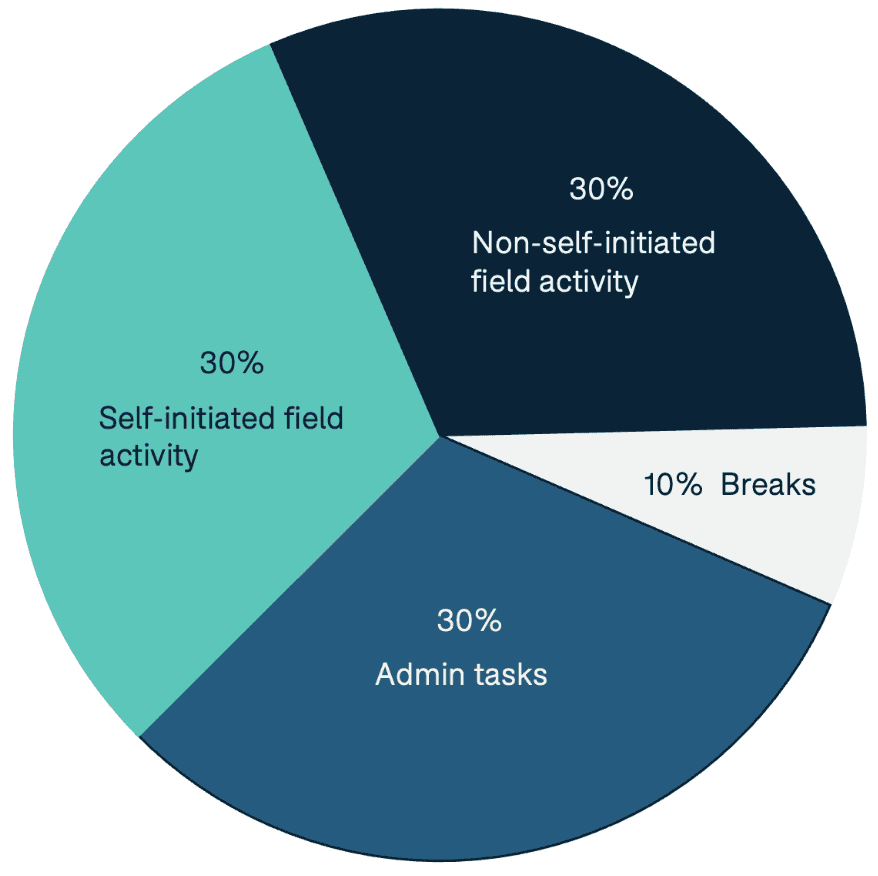
To determine what effective staffing should look like, the LCSO benchmarked patrol activity against industry standards. Peregrine and the LCSO referred to best practices recommended by the IACP and the Office of Community Oriented Policing Services (COPS). According to the IACP and COPS, a patrol officer should spend:
- 30% of their time proactively policing via self-initiated police activity (SIFA)
- 30% of their time responding to calls for service (non-SIFA)
- 30% of their time on administrative work
- 10% of their time on personal activities
🔎 WHAT IS SELF-INITIATED POLICE ACTIVITY (SIFA)?
SIFA refers to proactive police work that is not driven by 911 calls or dispatch, such as patrols, traffic stops, and community engagement.
This benchmark defines how patrol time should ideally be distributed between proactive work, reactive calls, and administrative duties. In practice, many agencies struggle to meet this balance.
To understand how the LCSO’s staffing compared to this benchmark, the Peregrine team worked closely with LCSO command staff to:
- Sift through CAD data and tag each CFS and corresponding unit response as SIFA or non-SIFA based on call type, call source, unit code, and other key criteria
- Analyze how much time Loudoun’s patrol officers actually spent on SIFA versus non-SIFA during their shifts, relative to the benchmark
- Model and analyze the average number of deputies on patrol over the course of each day
The analysis revealed a critical gap: Proactive policing dropped during peak community hours.
🧠 WHY IT MATTERS: Without visibility into how patrol time is actually spent, agencies risk under-staffing during peak hours, reducing officer visibility and community trust.
How the unit incident model measures patrol workload by hour
To get the actual breakdown of patrol officers’ time across each day, Peregrine implemented a unit incident model, which looks at the following metrics for each CFS:
- Whether the call qualifies as SIFA or non-SIFA
- How many units respond to the call
- Each unit’s response time
- The total time each unit spends on the incident
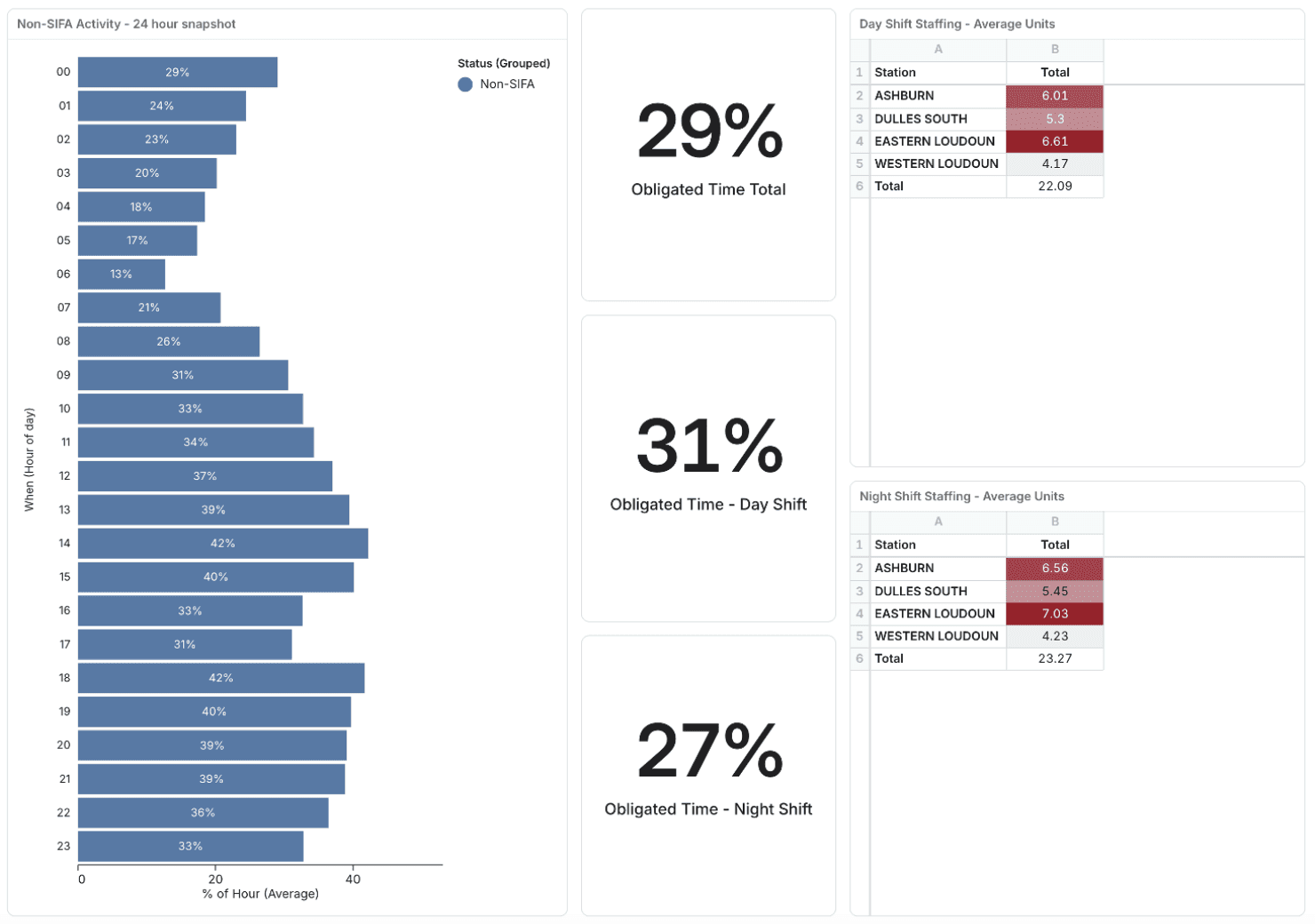
Peregrine applied the unit incident model to calculate the average number of total man hours Loudoun's patrol deputies collectively spent on SIFA calls during each hour of the day. The resulting analysis revealed dips in SIFA during times where there were higher volumes of non-SIFA calls.
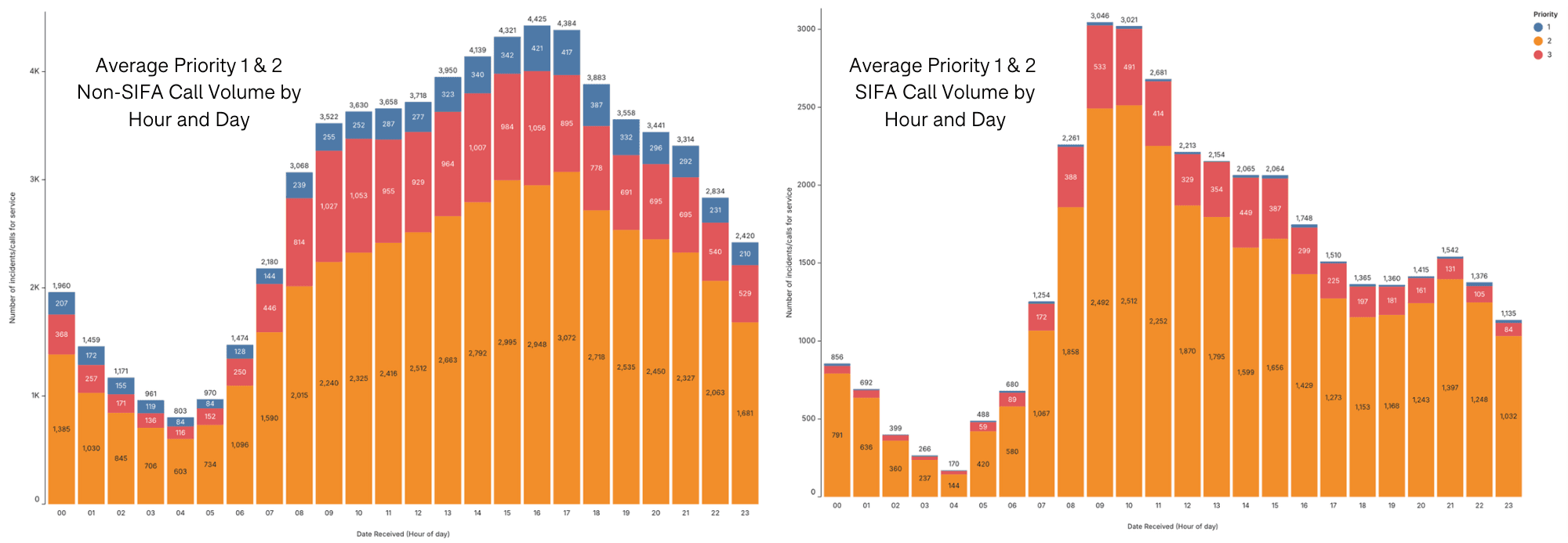
LCSO Maj. David Hill noted that the dips made sense — officers who are busy responding to non-SIFA calls have less time for proactive policing. But the dips also happened during the late afternoons and early evenings, which are high-traffic hours for many communities.
🔎 WHY DOES PROACTIVE POLICING DECLINE DURING PEAK HOURS?
As calls for service increase, officers spend more time responding to incidents, reducing time available for proactive work.
“The optics aren’t good if the hours when most people are out and about are the same hours when cops are the most preoccupied. People complain that they would like to see more deputies in their neighborhood,” Hill explained. “If we can manage the workload side, and we can have the right number of people on duty to handle the workload, we can also have the right number of people out there being proactive, hard-working cops.”
To address this gap, the LCSO used these insights to model staffing needs and redesign shift structures.
🔑 KEY TAKEAWAY: Agencies often lack visibility into how patrol time is actually spent. Peregrine revealed that proactive policing dropped during peak hours, enabling the LCSO to realign staffing and restore visibility when it mattered most.
How the LCSO calculated minimum patrol staffing requirements using real-time data
After determining the average time spent on SIFA calls per hour across all four sheriff’s office stations, Peregrine:
- Calculated the minimum number of deputies required per hour to both handle the workload and ensure compliance with the 30-30-30-10 staffing benchmark
- Compared the minimum deputy requirements with actual staffing numbers to identify staffing surpluses and deficits at various points throughout the day
- Applied a shift relief factor to account for outliers, such as time spent on training and leave
- Determined the total number of patrol officers the LCSO had to hire for its current shift schedule to meet demand and follow best practices
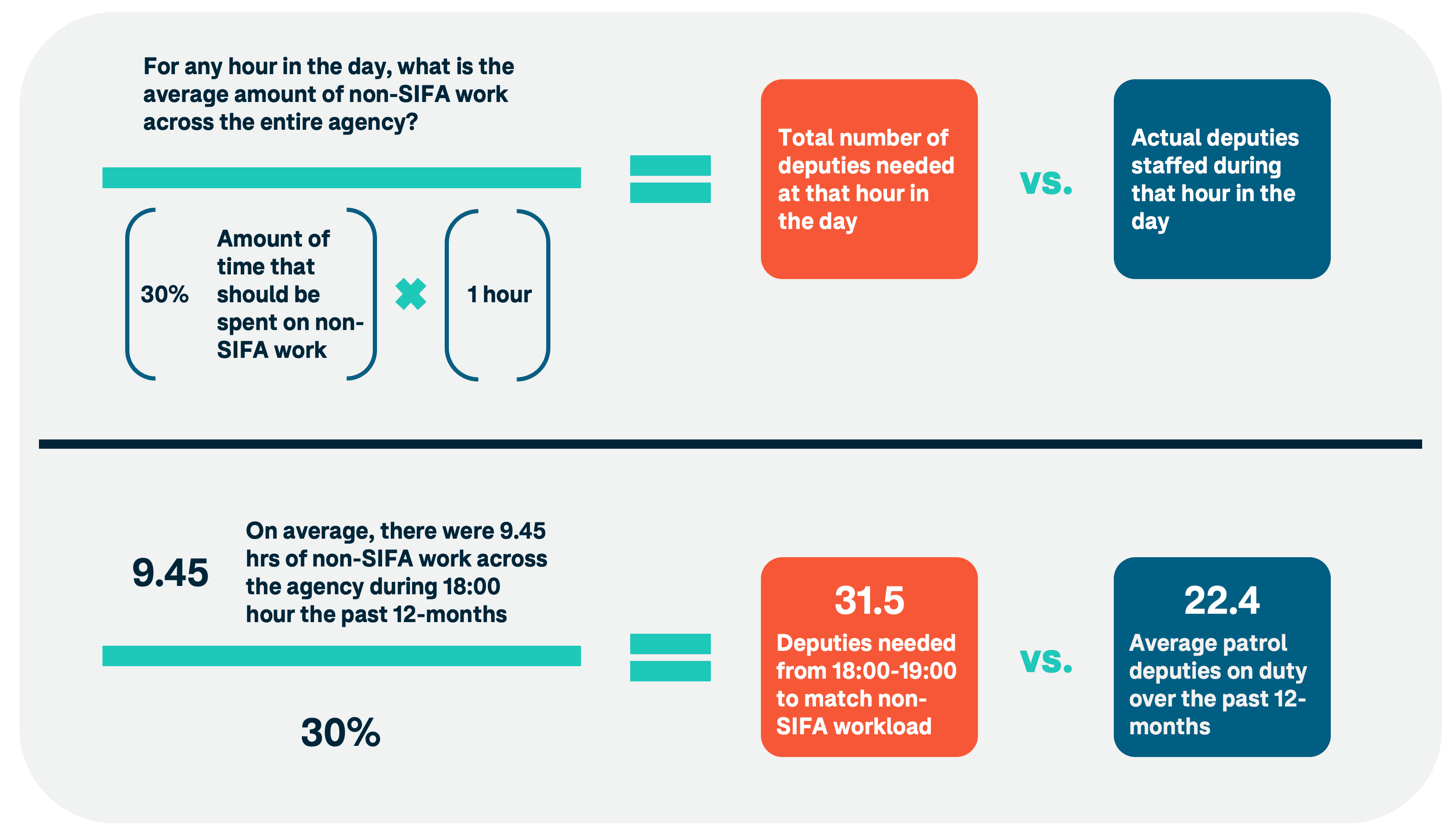
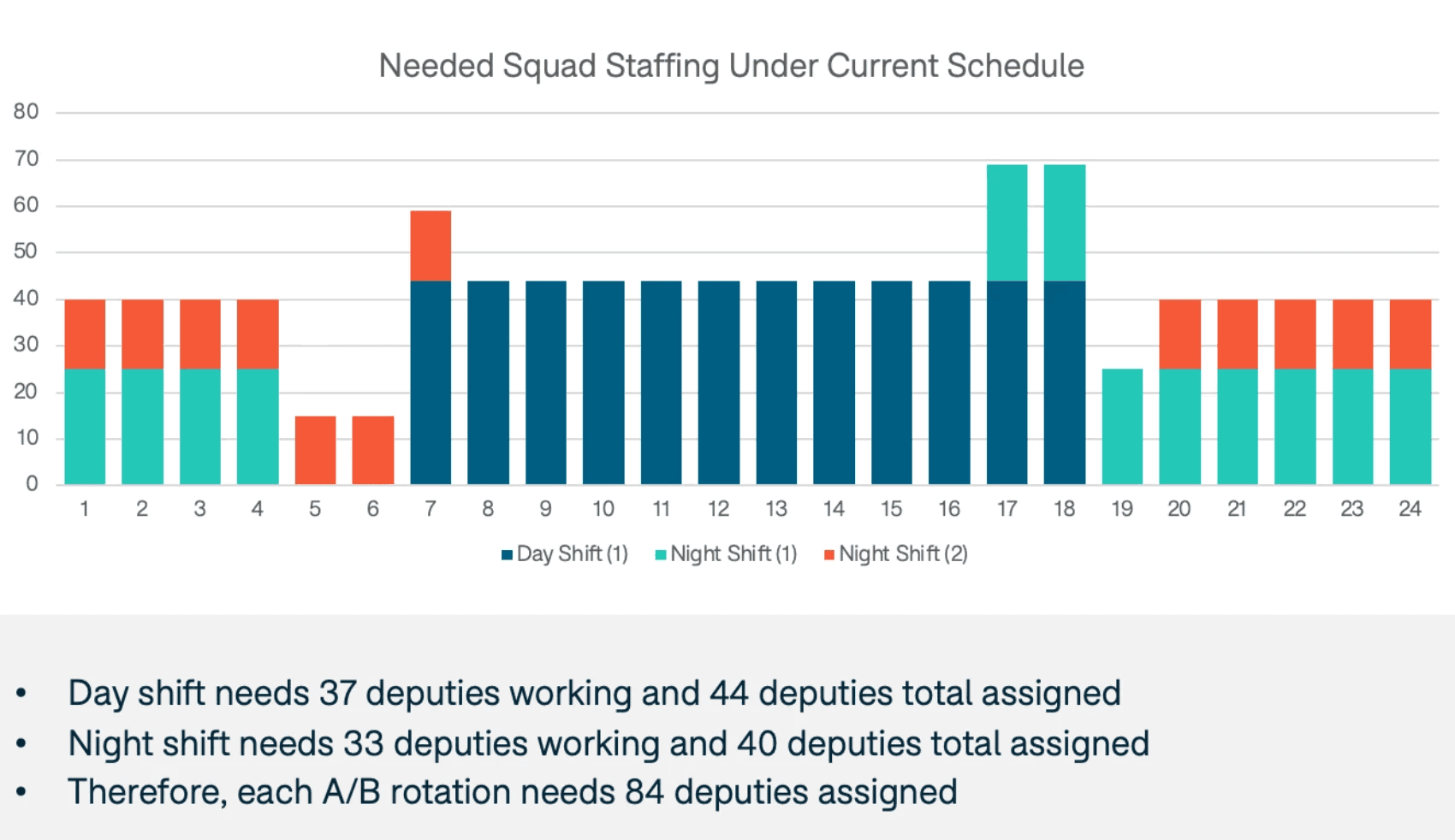
This analysis provided a clearer picture of where staffing levels met — or fell short of — operational demand.
Maj. Hill said that while the unit incident model shouldn’t be the sole deciding factor when it comes to patrol staffing, it does provide insight into staffing needs throughout the week.
“Response times aren’t a direct measure of your staffing,” Hill said. “We can’t specifically go, X number of deputies is going to increase or decrease your response times. But there’s a correlation.”
🔑 KEY TAKEAWAY: This analysis revealed when and where staffing levels fell short of demand, enabling the LCSO to define precise staffing requirements and hiring needs.
CASE STUDY → How The Fremont Police Department Uses CAD Data To Optimize Staffing and Resource Allocation
How the LCSO optimized patrol shift schedules to improve response times and officer safety
LCSO leadership used Peregrine’s analysis to inform a proposed overhaul of the agency’s patrol shift model. By aligning shifts and staffing to the workload-based model, the LCSO aims to better match the times that consistently see more calls for service and longer unit response times so the sheriff’s office can:
- Align patrol staffing with CFS demand trends
- Improve incident response times
- Improve second-unit arrival times to enhance officer safety
- Increase officer visibility in prime hours
- Expand proactive policing (SIFA) during high-traffic periods
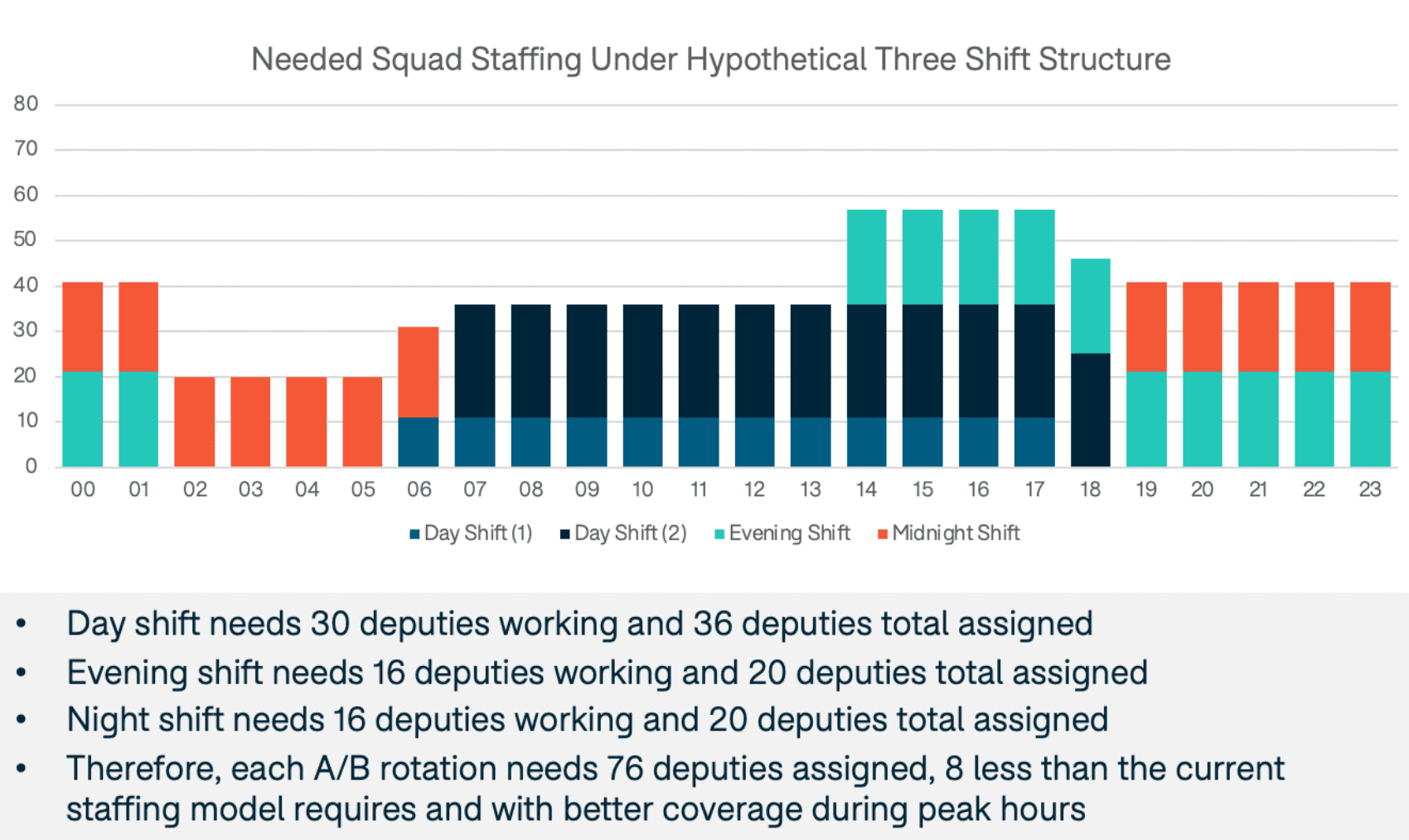
The proposed shift model would increase coverage during peak hours, while reducing overall minimum staffing requirements, from 84 assigned deputies to 76.
📊 KEY METRIC: The optimized shift model reduced minimum staffing needs from 84 to 76 deputies while improving coverage.
Still, “efficiency is not the only name of the game” when it comes to patrol staffing, according to Maj. Hill. When determining shift schedules, he said, it’s critical to weigh priorities and strike a balance between efficiency and wellness, such as trying to get the midnight shift staff home before the sun comes up.
“When you start making your model, you need to figure out what’s important to your organization and how it is that you’re going to slice things out,” Hill said. “I think this is the greatest thing about our new system and our relationship with Peregrine. We’ve had all this data for years, but we could never get it [right] ... Now, we can do it. I can do most of these reports on my computer, and I am not a computer programmer.”
🔑 KEY TAKEAWAY: By aligning staffing with real-world demand, the LCSO’s proposed shift model could improve response times, increase visibility, and balance officer safety with efficiency.
How data-backed staffing analysis helped the LCSO secure 14 new positions
Peregrine empowered the Loudoun County Sheriff’s Office to conduct complex workload analyses in-house. As a result, the agency was able to make data-informed changes to its minimum staffing requirements, optimize its patrol shift model, and secure resources for additional deputies from the Loudoun County Board of Supervisors.
“This past budget cycle, we went in front of our Board of Supervisors and talked all this through,” Sawyer said. “I think it resonated with them, and they gave us 14 additional positions.”
He said it was valuable to back up the LCSO's request for additional resources with objective, reliable data from Peregrine.
“These aren’t my numbers; these are industry best practices and standards established by the IACP,” Sawyer said. “That worked very well for us.”
With Peregrine, the LCSO now has a repeatable, data-driven approach to staffing, allowing leadership to continuously adapt to changing demand.
Contact our team to learn how Peregrine’s data integration technology can provide your agency with fast, affordable workload analysis services — accessible whenever you need them. And to explore the full potential of data integration in law enforcement, download our e-book, 21st Century Policing.


 Your Privacy Choices